
KRUVE EQ & PROPEL GLASSWARE Review
Does The Cup You Drink Your Coffee From Matter?
BENJAMIN SAND - JUNE 2026
Benjamin Sand is the editor of The Mouth and has tested portable projectors, espresso makers, and travel gear across years of nomadic travel through Southeast Asia, Europe, and beyond.
Build Quality ★★★★★ 5/5
Design ★★★★ 4/5
Value
★★★★
4/5
THE VERDICT ★★★★★ 4/5
Best For: Home enthusiasts or small coffee shops who want to elevate their tasting options by giving people the chance to experience changes in aroma and flavour.
Bottom Line: They really do work, but they are not for everyone.

INTRODUCTION
The specialty coffee community lives for hacks, fine-tuning everything that happens before the brew hits the vessel. Obsessing over burr geometry, grind consistency, filter paper speed, and constructing meticulous mineral profiles for our water chemistry. Yet, at the very end of this hyper-precise chain, we routinely dump a high-clarity, single-origin Gesha into a chunky, thick-walled ceramic mug that smothers the aromatics and burns our tongues.
The Kruve Glassware system treats the cup not as an afterthought, but as an active component of the tasting reverence.
Taking an obvious cue from the world of high-end sommelier wine glassware, the Kruve EQ line (consisting of the Excite, Inspire, and Propel espresso glass) claims to function as a literal hardware equalizer for your taste buds. The concept shifts the daily ritual away from passive consumption into sensory profiling.
They are striking, look completely alien on a standard kitchen counter, and bypass the boredom of traditional double-walled glass to deliver something deeply experiential.

WHO ARE KRUVE?
Kruve initially shook up the coffee community with their sifter systems, forcing baristas to acknowledge that even the most expensive grinders on earth produce a wide spectrum of micro-fines and boulder grinds. By designing multi-tiered sieves they proved that uniformity is the holy grail of clean, high-clarity extractions.
For the minimalist nomad or sensory enthusiast, Kruve offers an premium design language. Whether they are engineering carafes or scientifically tailored glassware, their philosophy is built on sensory optimization. They create gear meant to bridge the gap between technical data and pure physical enjoyment, validating the high prices we pay for ultra-light Nordic roasts by ensuring your body actually registers every single flavor note on the bag.

WHAT IS THE KRUVE EQ?
The Kruve EQ system is a pair of hand-blown, borosilicate sensory glasses made to manipulate the aromatic compounds and taste perception of specialty coffee. The set splits the tasting experience into two distinct physical geometries: the Excite glass and the Inspire glass.
Each unit accommodates 150ml of liquid, enough to ensure the coffee sits exactly where the technical design intended, though the total capacity can hold closer to 300ml.
The cups use an innovative double-to-single-wall construction method. The bottom half of each glass features an insulated double-walled pocket to preserve thermal stability and stop your fingers from burning. The top portion transitions into a thin, single-walled rim. This unique hybrid structure means the vessel stays cool to the touch while maintaining the precise profile needed to properly direct the liquid onto the specific taste receptors of the tongue.

WHAT IS THE PROPEL?
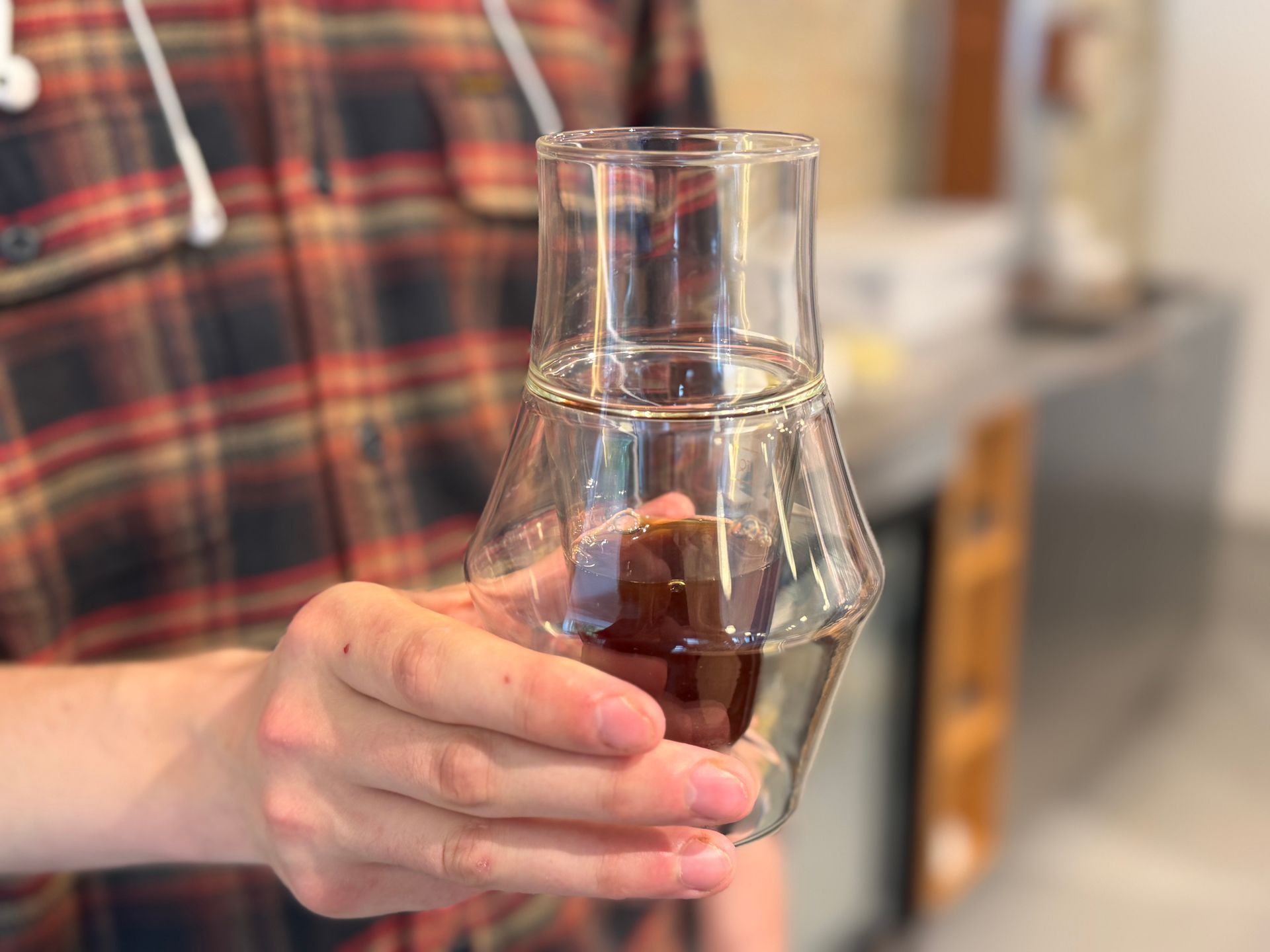
Nesting a 75ml capacity inside that signature double-to-single-wall borosilicate frame, the Propel design prioritizes a massive, bulbous headspace that acts as an funnel to capture volatile aromatics. It gives your nose room to breathe while you sip, pulling out those delicate, fruit-forward origin notes from light-roasted coffees that usually get entirely smothered by dense crema in a tight, narrow shot glass.
They look undeniably striking, and the fins inside the glass act as a natural barrier to aid swirling, so that your espresso mixes correctly and the crema does not pierce your palate with unwanted bitterness.

WHAT I LIKE
- The double-to-single-wall borosilicate glass engineering is brilliant, providing great thermal retention in the base while maintaining an ultra-thin single lip that gives you an exceptional mouthfeel and controlled sip.
- The physical shape is functional rather than placebo; side-by-side tastings reveal that the wide surface area of the Excite glass consistently rounds out harsh edges and highlights sweetness in medium-to-dark roasts.
- The Inspire glass focuses volatile aromatics, using a narrow headspace that acts as a physical funnel to shoot vibrant, fruity acidity straight to the front of the palate when drinking light, floral pour-overs.
- The Propel gives you an extra oomph when tasting espresso with high acidity or fruit-notes, making sure your coffee can release its aroma and the tasting notes will find their place.
- The clear, hand-blown design offers visual clarity, allowing you to fully appreciate the clarity, hue, and texture of a light, clean filter brew.
- The outer shapes of the EQ glasses are exact geometric inverses of one another, delivering a beautifully symmetric visual balance on a workspace or kitchen shelf.
Watch James Hoffmann review the Kruve

WHAT I DON'T LIKE
- With an optimal fill line capped at just 150ml, the capacity can feel restrictive for home baristas who brew larger pours.
- The delicate, hand-blown borosilicate construction feels incredibly fragile and requires cautious hand-washing, making it a stressful (impossible) addition to a rugged, mobile travel pack.
- The odd shape may not appeal to everyone, and the shape of the glasses is quite wide for those of smaller hands, depending where you hold your coffee cup.
- The shape of the bulbous Excite glass make it surprisingly difficult to wipe completely dry, often leading to stubborn water spots if left to air-dry.

Final Thoughts
The Kruve EQ system is not a casual mug replacement; it is a dedicated piece of hardware for coffee connoisseurs. If your daily routine consists of throwing dark roasted beans into a machine and rushing out the door with a splash of milk, these glasses will feel like an absurd, over-engineered gimmick.
However, if you view coffee through a lens of origin character, processing styles, and acidity, the EQ glasses are a revelation. They take the exact same brew and highlight entirely different structural pillars of the bean purely through rim architecture and the way the liquid enters your mouth.
By treating the cup with the same respect a vineyard treats a Bordeaux glass, Kruve has created a compelling, gorgeous tasting kit that rewards slow, intentional brewing and changes the entire sensory geometry of your morning extraction.
FAQ
What is the actual capacity of the Kruve EQ glasses?
Each glass is optimized for 150ml. While the total physical volume of the glass can technically accept up to 300ml if filled to the absolute brim, pouring that high defeats the engineering and neutralizes the benefits of the double-wall base.
Can you wash the Kruve EQ glassware in a dishwasher?
You can, but it's probably safer in the long run to hand-wash.
What is the core functional difference between the Excite and Inspire glasses?
The Excite glass features a bulbous, wide internal shape with an expansive liquid surface area designed to maximize oxidation, trap heavy aromatics, soften intense acidity, and boost overall sweetness. The Inspire glass uses a narrow, elongated inner architecture that minimizes surface air exposure to focus delicate, volatile fruit aromas and emphasize crisp, bright acidity.
Why is the rim of the glass single-walled if the base is double-walled?
Standard double-walled coffee glasses have thick, blunt rims that force you to gulp or slurp clumsily, disrupting the flow of coffee. Kruve uses a single-wall rim to keep the lip thin, allowing the liquid to slide smoothly onto your tongue, while keeping the double-walled insulation restricted to the lower half where your fingers hold the glass.


